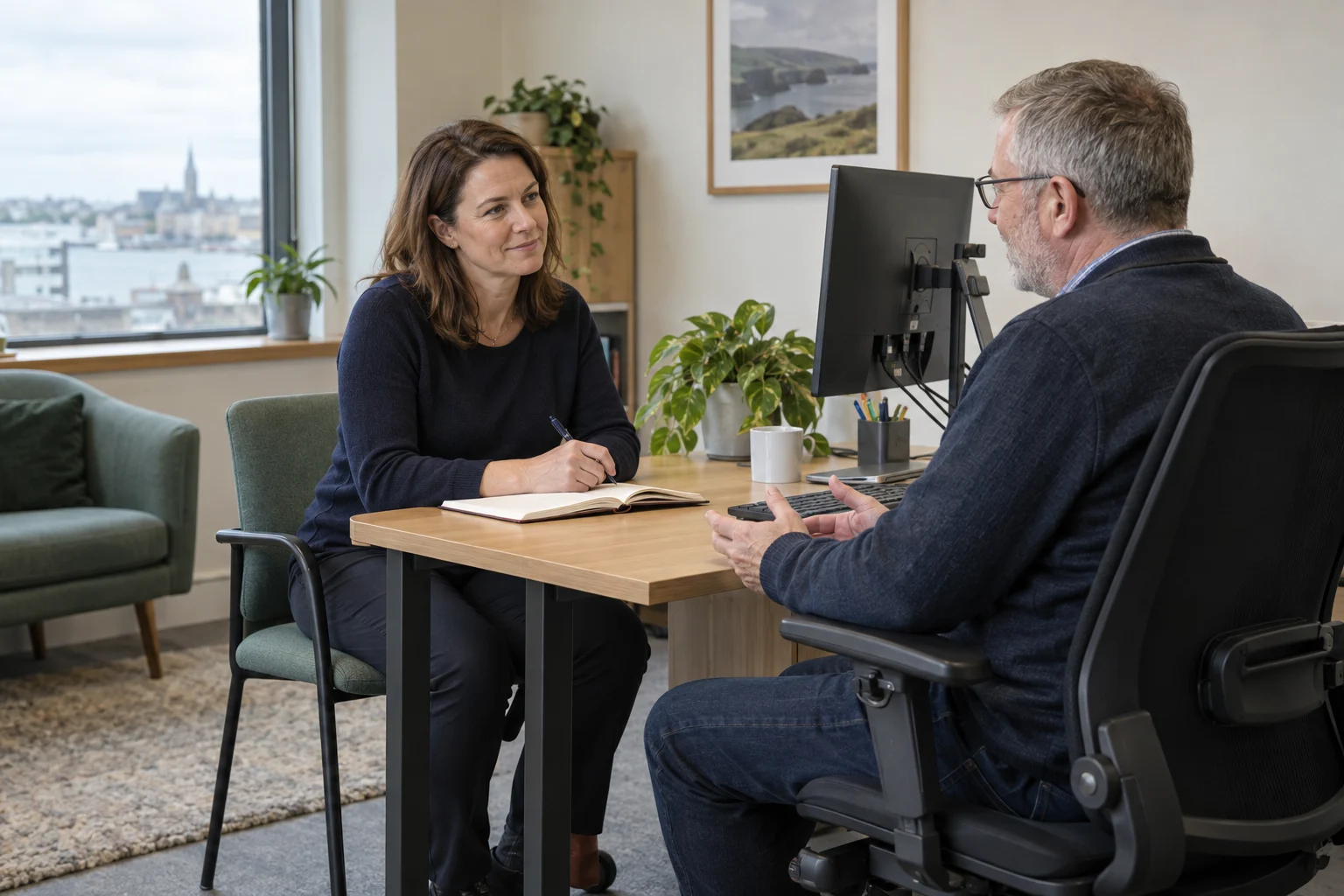
When does an employee need a DSE assessment, and when is a deeper specialist ergonomic assessment more appropriate?
Ergonomic Assessment vs DSE Assessment: What's the Difference?
It's one of the most common questions we get. They sound similar, they're sometimes done by the same provider, and the regulatory landscape uses both terms — so it's reasonable to ask which is which, and when each one is the right move.
Short answer: they're different services solving different problems. A DSE assessment is the structured workstation analysis required for covered screen users. A specialist ergonomic assessment goes further where the task, symptoms, return-to-work context or work environment requires more detailed analysis.
This guide explains the practical differences and gives you the decision rule we use with clients.
The one-paragraph answer
A DSE assessment is an individual workstation analysis for an employee covered by the DSE provisions of SI 299/2007. It evaluates the workstation, working method and relevant eyesight, physical and mental-stress risks against the regulatory requirements. A specialist ergonomic assessment is a broader or deeper evaluation of how the person, tasks, equipment, environment and work organisation interact. It may be used for persistent symptoms, return-to-work cases, complex non-screen environments or where a DSE assessment recommends specialist input. See the HSA guide to the DSE regulations for the statutory DSE requirements.
Side by side
DSE Assessment | Ergonomic Assessment | |
|---|---|---|
Legal driver | Regulation 72 analysis for covered DSE users | Broader risk assessment, occupational-health referral or a defined service/framework scope |
Trigger | A covered DSE user needs an individual workstation analysis, or an existing analysis needs review | Reported symptoms, return-to-work, complex tasks or a need for specialist input |
Typical Usafety duration | 30–45 minutes | Varies by scope; Usafety's two-stage cases can involve a consultation plus a longer onsite review |
Delivery | Remote (Teams) or onsite | Two-stage: phone/virtual + onsite |
Practitioner | A competent person with appropriate training, knowledge and experience | A practitioner whose ergonomics qualifications and experience match the task and case complexity |
Focus | Workstation, screen, input devices, environment, working method and breaks | Person + tasks + equipment + environment + work organisation + relevant health context |
Output | Documented analysis + corrective actions | Detailed specialist report + recommendations + agreed follow-up |
Review | On workstation/equipment/technology change and when the existing analysis may no longer be adequate | Case-by-case according to risk, recommendations and referral pathway |
Procurement | Confirm any applicable public-sector framework scope and buyer eligibility | Confirm any applicable public-sector framework scope, referral requirements and buyer eligibility |
When to use which — the decision rule
The rule we use with clients:
If a covered employee uses a straightforward screen workstation and needs the individual analysis required by the DSE regulations, run a DSE assessment.
If the employee has reported symptoms, is returning from injury, works in a complex environment, or had a DSE assessment that flagged something needing specialist review, run an ergonomic assessment.
In practice, most organisations run DSE assessments routinely across their workforce, and commission ergonomic assessments case-by-case as specific issues emerge.
What a DSE assessment looks like
A DSE assessment is a structured walkthrough of the user's workstation:
Chair height, back support, armrests, lumbar support
Desk height, knee clearance, foot positioning
Monitor height, distance, angle, brightness
Keyboard and mouse position; hand and wrist posture
Lighting and reflections
Surrounding environment — noise, temperature, layout
Posture during typical tasks
Break patterns and work organisation
Any reported aches, pains, fatigue or visual symptoms
The output is a report with case-specific corrective actions, such as adjusting the chair or screen, changing the workstation layout, or considering suitable additional equipment where the assessment identifies a need.
Remote DSE assessments are delivered via Microsoft Teams. The user connects from a browser link — no software install — and the assessor walks through the same checklist via video.
At Usafety, this standard service typically takes 30–45 minutes. That is an operational service norm, not a duration prescribed by law.
What an ergonomic assessment looks like
A specialist ergonomic assessment is broader and more detailed. Usafety commonly delivers this as a two-stage engagement; this is Usafety's service model, not a single format prescribed for every Irish provider or case.
Stage 1 — Telephone or virtual consultation
The ergonomist speaks with the employee and, where appropriate and agreed, the line manager or occupational-health contact to understand the case. This includes:
The employee's symptoms or relevant health context, within the appropriate consent and occupational-health process
Their role, tasks and typical day
The history of any prior interventions
The work environment (office, clinical, lab, line, mixed)
Equipment in current use
Usafety's Stage 1 typically takes 45–60 minutes. Confirm the assigned practitioner, their current qualifications and professional-membership grade, and any framework requirements in the quotation for each engagement.
Stage 2 — Onsite assessment
The assigned, appropriately qualified practitioner visits the workplace, observes the employee performing relevant work, takes agreed measurements, photographs and notes, and produces a detailed ergonomic report. Health information and photographs should only be collected and shared through the agreed privacy and occupational-health process.
Usafety's Stage 2 onsite visit typically takes 1.5–2.5 hours. Report timing is agreed in the quotation; any 5–10-working-day expectation should be confirmed for the specific engagement rather than presented as an industry rule.
Concrete examples
To make the distinction practical, here are five illustrative scenarios based on common referral patterns. They are not presented as identifiable client cases.
Example 1: Routine office DSE programme — DSE assessment
A large public-sector organisation wants to run DSE assessments across administrative staff. No specific individual symptoms have been reported. The goal is to complete the required per-user analysis and manage corrective actions across the workforce.
Right product: DSE assessment programme. Remote delivery via Teams. Reports flow into the organisation portal. Specialist ergonomic referrals can be triaged separately when an individual assessment identifies an issue outside the routine DSE scope.
Example 2: Office worker with persistent neck pain — Ergonomic assessment
A 38-year-old office worker has reported persistent neck pain for 6 months. Occupational health has reviewed but the pain continues. The line manager has asked for further specialist input.
Right product: Specialist ergonomic assessment. The case has a health and work dimension that a routine DSE assessment is not designed to resolve. The assessment can cover the workstation and work organisation and, where appropriate, recommend that the employer or employee follow the relevant occupational-health or clinical referral pathway.
Example 3: Hospital ward — clinical environment — Ergonomic assessment
A hospital ward is reporting increasing back-and-shoulder issues across its nursing staff. The role involves patient transfers, hoist use, screen-based clinical documentation, and prolonged standing.
Right product: Specialist ergonomic assessment. Hospital ward ergonomics is fundamentally different from office ergonomics — patient handling, working posture, equipment competence and shift design may all need consideration. Framework eligibility must be determined from the current procurement documents for the buyer and case rather than assumed from the setting.
Example 4: Return-to-work after back injury — Ergonomic assessment (and potentially FCE)
An employee is returning to work after a 4-month absence following a back injury. They are now medically cleared but the line manager and the employee are uncertain about workstation adjustments and any role accommodations needed.
Right product: Specialist ergonomic assessment. Depending on the referral question and occupational-health advice, a Functional Capacity Evaluation (FCE) may also be considered to assess specified functional demands. It should not be presented as an automatic prerequisite.
Example 5: Lab researcher with shoulder pain — Ergonomic assessment
A laboratory researcher is reporting persistent shoulder pain. Their work involves pipetting, microscope use, gowning and prolonged standing — none of it screen-based.
Right product: Ergonomic assessment, not DSE. The screen is not the issue. Laboratory ergonomics is a specialist sub-discipline; a routine DSE assessment isn't equipped for it.
Why the distinction matters operationally
The two products are also priced and procured differently. DSE assessments scale efficiently — per-employee unit cost is low and the assessor-time per assessment is short. Ergonomic assessments are higher-ticket, lower-volume engagements with longer assessor time.
For eligible public-sector buyers, the procurement route matters. Buyers should confirm the current framework scope, lot name, supplier status and drawdown eligibility in the procurement documents before purchase. Private employers can engage a provider directly.
For private-sector buyers, the practical impact is on triage. If a DSE programme flags 60 cases needing further review, that does not automatically mean 60 specialist ergonomic assessments. Triage which cases need specialist input, which require occupational-health review and which can be resolved through routine corrective action.
Where Usafety fits
Usafety delivers DSE assessments remotely and onsite, and scopes specialist ergonomic work as a separate service. Public-sector procurement routes, assigned practitioners and eligibility are confirmed in the current procurement documents and quotation rather than assumed from older framework names.
Our DSE programmes can use an organisation portal, dashboard and self-booking workflow. Ergonomic engagements are scoped case by case, with the report format and review process agreed in the quotation.
See the DSE assessment service → See the ergonomic assessment service →
Frequently asked questions
Is an ergonomic assessment the same as a DSE assessment?
No. A DSE assessment is the individual workstation analysis required under SI 299/2007 for covered display-screen users. A specialist ergonomic assessment goes further and can address complex tasks, persistent symptoms, return-to-work cases or non-screen work in settings such as laboratories, healthcare and production.
When does my team need an ergonomic assessment?
When an employee reports persistent pain, returns from injury, has a specific clinical reason for a tailored setup, works in a role with significant non-screen risk, or where the DSE assessment recommended further specialist review.
Who is qualified to deliver an ergonomic assessment in Ireland?
A practitioner whose qualifications, knowledge and experience match the work and case complexity. IHFES membership can be a useful professional signal, but it is not by itself a chartered credential. Health-related cases should also follow the employer's occupational-health and clinical referral arrangements.
How much does an ergonomic assessment cost?
Pricing depends on volume, delivery format and any applicable procurement route. Usafety currently aims to return bespoke quotations within 4 working hours; that is a service target rather than a regulatory standard.
Does every ergonomic assessment follow the same format?
No. The scope should reflect the risk, task and reason for referral. Regulation 72 and Schedule 4 set requirements for DSE workstation analysis; broader ergonomic assessments are scoped to the work and case.
Published by Usafety. This guide provides general information and is not legal or clinical advice.
Need a DSE programme? See Usafety's DSE service. For a complex or non-screen case, see the ergonomic assessment service.